The Solow Growth Model Revisited
Week 07
April 20, 2026
1. The model’s structure
The Solow model: structural form
The Solow growth model has 6 equations x 6 variables: \[ \begin{array}{ll} Y_t=K_t^\alpha\left(A_t L_t\right)^{1-\alpha} & , \quad \text { production function } \\[4pt] K_{t+1}=K_{t}+I_{t}-\delta K_{t} & , \quad \text { capital accumulation } \\[4pt] I_t=s Y_t & , \quad \text { investment } \\[4pt] L_t=(1+g_{_L}) L_{t-1} & , \quad \text { labor accumulation (exogenous) } \\[4pt] A_t=(1+g_{_A}) A_{t-1} & , \quad \text { technology accumulation (exogenous) } \\[4pt] Y_t \equiv C_t+I_t & , \quad \text { income accounting identity } \end{array} \]
Parameters:
- Capital-output elasticity (also the share of capital in national income): \(\ 0<\alpha<1\)
- Depreciation rate: \(\delta>0\)
- Savings rate: \(0<s<1\)
Exogenous growth rates: \(\{g_{_L}, g_{_A}\}\)
2. Solving the model
The Solow trick
Complicated model to simulate without a computer (6 equations x 6 variables!)
Solow overcome that problem by using variables defined in intensive units: \[ \begin{aligned} &y_t \equiv \frac{Y_t}{A_t L_t}, \quad k_t \equiv \frac{K_t}{A_t L_t}, \quad c_t \equiv \frac{C_t}{A_t L_t}, \quad i_t \equiv \frac{I_t}{A_t L_t} \end{aligned} \]
By doing this, the intensive production function can be written as: \[y_t = k_t^\alpha \tag{1}\]
Proof
\[ \begin{aligned} &y_t \equiv \frac{Y_t}{A_t L_t}=\frac{K_t^\alpha\left(A_t L_t\right)^{1-\alpha}}{A_t L_t}=\frac{K_t^\alpha\left(A_t L_t\right)^{-\alpha}\left(A_t L_t\right)^1}{\left(A_t L_t\right)^1}=\frac{K_t^\alpha}{\left(A_t L_t\right)^\alpha}=k_t^\alpha \end{aligned} \]
The fundamental equation and the steady-state
The entire model can be captured by the fundamental equation (see Appendix A):
\[ k_{t+1}=\frac{1}{\phi}\left[(1-\delta) k_t+s \cdot k_t^\alpha\right] \quad , \quad \phi \equiv \color{red}{(1+g_A)(1+g_L)}\tag{2} \]The steady-state of the Solow model is obtained when: \[ k_{t+1}=k_{t}=\overline{k} \]
By substituting this condition into (2), we get: \[ \overline{k} = \frac{1}{\phi} \left[ (1-\delta) \overline{k}+s \cdot (\overline{k})^{\alpha} \right] \tag{3} \]
Solving eq. (3) for \(\overline{k}\), and using the definition of \(\phi\) in eq. (2), we get: \[ \overline{k}=\left(\frac{s}{g_{_A}+g_{_L}+g_{_A}g_{_L} +\delta}\right)^{\frac{1}{1-\alpha}} \tag{4} \]
Graphical analysis
- Graphically, the steady state can be found when the curve given by eq. (2) crosses the 45-degree line in the usual plane:
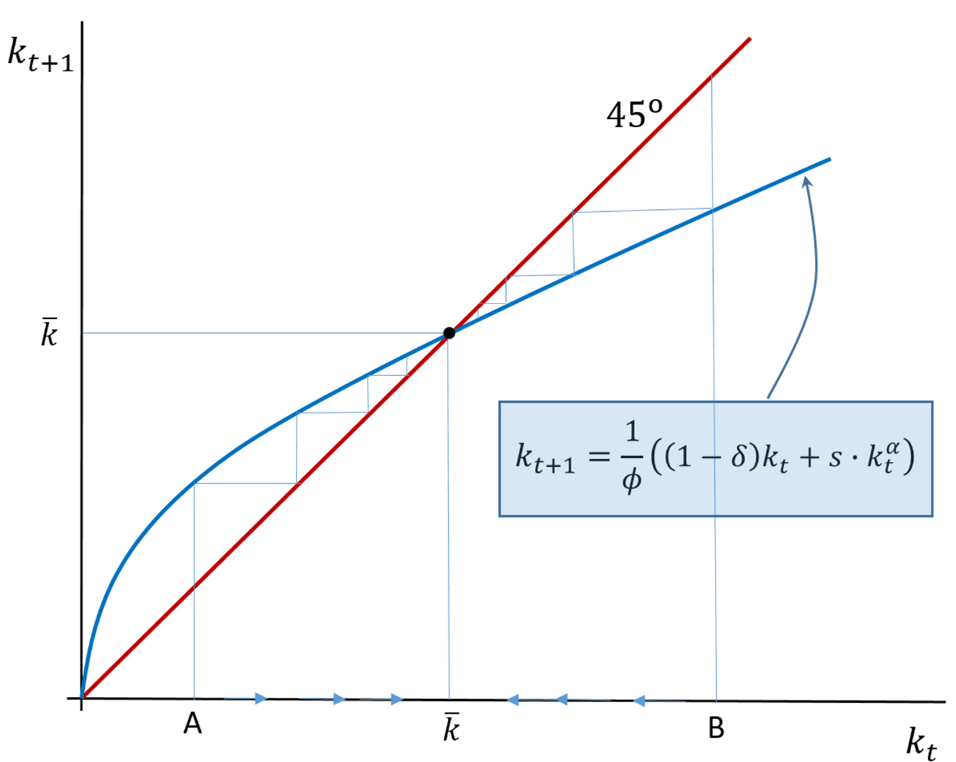
- The equilibrium exists and is stable.
- If \(k_1 < \bar{k}\), then \(k\) will increase until it reaches \(\bar{k}\).
- If \(k_1 > \bar{k}\), then \(k\) will decrease until it reaches \(\bar{k}\).
Growth in the steady-state (I)
We have three different classes of variables:
- Variables measured in intensive units: \(k\ , \ y \ , \ i \ , c\)
- Variables measured in actual units: \(K \ , \ Y \ , \ I \ , C\)
- Variables measured in per capita units: \(\frac{K}{L}\ , \ \frac{Y}{L}\ , \ \frac{I}{L}\ , \ \frac{C}{L}\)
By definition, in the steady state, \(k\) remains constant over time as: \[k_{t+1}=k_{t}=\bar{k}\]
So, its growth rate has to be: \[g_{_{k}}=0 \tag{5}\]
But what happens to all the other variables?
Growth in the steady-state (II)
Variables measured in intensive units grow at the rate (see proof in Appendix B): \[ g_{_k} = g_{_c} = g_{_y}= g_{_i} = 0 \]
Variables measured in actual units will grow at the rate (Appendix C): \[ g_{_K} = g_{_C} = g_{_Y} = g_{_I} = \color{red}{g_{_A}+g_{_L}+g_{_A}g_{_L}} \]
Variables measured in per capita units will grow at the rate ( Appendix D): \[ g_{_{K/L}} = g_{_{C/L}} = g_{_{Y/L}} = g_{_{I/L}} = \color{red}{g_{_A}} \]
Appendix A
Proof of the fundamental equation of the Solow model
Jump back to Eq. (2)
The accumulation of capital in intensive form
- We already know that the capital accumulation equation is
\[ K_{t+1}=K_{t}+\underbrace{I_{t}}_{=s \cdot Y_{t}}-\delta \cdot K_{t} \tag{A.1} \]
- For simplicity, call the product of labor and technology \(\left(A_t N_t\right)\) as labor measured in efficiency units, or simply \(E_t\)
\[ E_t \equiv A_t N_t \tag{A.2} \]
- Divide both sides of eq. (A1) by \(E_{t} (\equiv A_{t} N_{t})\)
\[ \frac{K_{t+1}}{E_{t}}=\frac{K_{t}}{E_{t}}+s \frac{Y_{t}}{E_{t}}-\delta \frac{K_{t}}{E_{t}} \tag{A.3} \]
Another trick
- Now, apply a trick to the left hand side of eq. (A.3)
\[ \frac{K_{t+1}}{\color{red}{E_{t+1}}} \frac{\color{red}{E_{t+1}}}{E_{t}}=\frac{K_{t}}{E_{t}}+s \frac{Y_{t}}{E_{t}}-\delta \frac{K_{t}}{E_{t}} \tag{A.4} \]
- Apply the definitions of intensive variables to simplify our previous result
\[ k_{t+1} \frac{E_{t+1}}{E_{t}}=k_{t}+s \cdot y_{t}-\delta \cdot k_{t} \tag{A.5} \]
- Get rid of the term above \(\frac{E_{t+1}}{E_{t}}\) by using the following result (see proof at the end of this appendix):
\[ \frac{E_{t+1}}{E_{t}}=(1+m)(1+n) \tag{A.6} \]
Voilá! the fundamental equation
Substitute eq. (A.6) into eq. (A.5) \[k_{t+1} \underbrace{(1+m)(1+n)}_{\equiv \ \phi} = k_{t}+s \cdot y_{t}-\delta \cdot k_{t} \tag{A.7}\]
Notice that \((1+m)(1+n) \equiv \phi\) is just a simplification.
Now, substitute eq. (1) — \(y_t = k_t^\alpha\) — into eq. (A.7), and we get: \[\phi k_{t+1}=(1-\delta) k_t+s \cdot k_t^\alpha\]
Or, in a more friendly way, our fundamental equation: \[ k_{t+1}=\frac{1}{\phi}\left[(1-\delta) k_t+s \cdot k_t^\alpha\right] \tag{A.8} \] Jump back to Eq. (2)
Proof
If \(E_{t+1} \equiv A_{t+1} L_{t+1}\) and \(E_{t} \equiv A_{t} L_{t}\), then, by using the equations of labor and technology accumulation, we can write: \[ \frac{E_{t+1}}{E_{t}}=\underbrace{\frac{A_{t+1}}{A_{t}}}_{(1+g_{_A})} \ \underbrace{\frac{L_{t+1}}{L_{t}}}_{(1+g_{_L})}=(1+g_{_A})(1+g_{_L}) \tag{A.9} \] Notice that, as by definition \(\frac{E_{t+1}}{E_{t}} \equiv 1+g_{_E}\), we can write: \[1+g_{_E}=(1+g_{_A})(1+g_{_L})\tag{A.10}\]
Appendix B
Proof: steady state intensive units growth rates
Jump back to Growth in the steady state
Intensive units: steady state growth rates
By definition, in the steady state: \(g_{_k}=0\). From eq. (1) we have \(y_t = k_t^\alpha\), so: \[g_{_y} = \frac{y_{t+1}}{y_t} - 1 = \frac{k_{t+1}^\alpha}{k_t^\alpha} - 1 = \left(\frac{k_{t+1}}{k_t}\right)^\alpha - 1 = (1+g_{_k})^\alpha - 1 \tag{B.1}\]
However, as in the steady state, \(g_{_k}=0\), eq. (B.1) simplifies to: \[g_{_y} = (1+0)^\alpha - 1 = 1 - 1 = 0\]
Let us see what happens in the case of \(i_t\). By definition, \(i_t = s \cdot y_t\). So: \[g_{_i} = \frac{i_{t+1}}{i_t} - 1 = \frac{s \cdot y_{t+1}}{s \cdot y_t} - 1 = \frac{y_{t+1}}{y_t} - 1 = (1+g_{_y}) - 1 = g_{_y} = 0\]
Finally, what happens to \(c_t\)? By definition, \(c_t = (1-s)y_t\). So: \[g_{_c} = \frac{c_{t+1}}{c_t} - 1 = \frac{(1-s)y_{t+1}}{(1-s)y_t} - 1 = \frac{y_{t+1}}{y_t} - 1 = (1+g_{_y}) - 1 = g_{_y} = 0\]
So, we have proved that: \[ g_{_k} = g_{_c} = g_{_y}= g_{_i} = 0 \] Jump back to Growth in the steady state
Appendix C
Proof: steady state actual units growth rates
Jump back to Growth in the steady state
Actual units: steady state growth rates (I)
If by definition \(k_t \equiv \frac{K_t}{A_t L_t}\), then the anual growth rate of \(k\) will be given by: \[g_{_{k}} \equiv \frac{k_{t+1}}{k_t} - 1= \frac{K_{t+1}}{K_t} \frac{E_t}{E_{t+1}} - 1 = \frac{1+g_{_{K}}}{1+g_{_{E}}} -1 \tag{C.1}\]
From eq. (C.1) we get that:
\[1+g_{_{K}} = (1+g_{_{E}}) (1+g_{_{k}}) \tag{C.2}\]
However, in the steady-state \(g_{_{k}}=0\). So eq. (C.2) can be simplified as:
\[1+g_{_{K}} = 1+g_{_{E}} \implies g_{_{K}} = g_{_{E}} \tag{C.3}\]
As from eq.(A.10) \(1+g_{_{E}}=(1+g_{_A})(1+g_{_L})\), then (C.3) becomes: \[g_{_{K}} = \color{red}{g_{_A}+g_{_L}+g_{_A}g_{_L}} \tag{C.4}\]
Actual units: steady state growth rates (II)
We can compute the growth rate of \(Y_t\) as follows: \[ \begin{aligned} 1+g_{_{Y}} = \frac{Y_{t+1}}{Y_t} &= \frac{K_{t+1}^\alpha\left(A_{t+1} L_{t+1}\right)^{1-\alpha}}{K_t^\alpha\left(A_t L_t\right)^{1-\alpha}} \\[6pt] & = (1+g_{_K})^\alpha(1+g_{_A})^{1-\alpha}(1+g_{_L})^{1-\alpha} = (1+g_{_K})^\alpha(1+g_{_E})^{1-\alpha} \\[6pt] \end{aligned} \]
As from eq. (C.3) we have \(1+g_{_K} = 1+g_{_E}\), then the previous equation can be written as: \[1+g_{_{Y}} = (1+g_{_E})^\alpha(1+g_{_E})^{1-\alpha} = 1+g_{_E} = \color{red}{(1+g_{_A})(1+g_{_L})} \tag{C.5}\]
Therefore, we can finally obtain: \[g_{_{Y}} = g_{_{K}} = \color{red}{g_{_A}+g_{_L}+g_{_A}g_{_L}} \tag{C.6}\]
You should be able to prove that: \(g_{_I} = g_{_C} = \color{red}{g_{_A}+g_{_L}+g_{_A}g_{_L}}\)
Appendix D
Proof: steady state per capita units growth rates
Jump back to Growth in the steady state
Per capita units: steady state growth rates
By definition the annual growth rate of \(K/L\) is given by: \[g_{_{K/L}}= \frac{\frac{K_{t+1}}{L_{t+1}}}{\frac{K_t}{L_t}}-1 = \frac{K_{t+1}}{K_t} \frac{L_t}{L_{t+1}} - 1 = \frac{1+g_{_{K}}}{1+g_{_{L}}}-1 \tag{D.1}\]
But we know that from eq. (C.5) we have:
\[1+g_{_{K}} = 1+g_{_{E}} = (1+g_{_{A}}) (1+g_{_{L}}) \tag{D.2}\]
by inserting eq, (D2) into eq. (D1), we get:
\[g_{_{K/L}}= \frac{(1+g_{_{A}}) (1+g_{_{L}})}{1+g_{_{L}}}-1 = 1+g_{_{A}}-1 = \color{red}{g_{_{A}}} \tag{D.3}\]
Once we know that \(g_{_{K/L}}= g_{_{A}}\), it will not be difficult to prove that:
\[g_{_{Y/L}}= g_{_{I/L}}= g_{_{C/L}}= \color{red}{g_{_{A}}} \tag{D.4}\] Jump back to Growth in the steady state
5. Readings
Readings
- Any modern macroeconomics textbook will include chapters on the Solow growth model. Some of them use continuous time and differential equations to describe the model, while others use discrete time and difference equations.
- We use discrete time and difference equations in this set of slides, and discrete time will also be used in the rest of the course. So, avoid the reading of textbooks that use continuous time and differential equations.
- For an economist, discrete time is more intuitive and easier to work with than continuous time, and that explains our choice here.
- If you want to get some further information about the Solow growth model, using discrete time, a good bibliographical reference is Daron Acemoglu (2008). Introduction to Modern Economic Growth. Princeton University Press. See Chapter 2: The Solow Growth Model, pages 34-47, to be found here (courtesy of the Princeton University Press): \(~\)here
